Most teams build AI agents asking, "Can AI handle this entire choice?"
MIT's framework flips the script: which specific slice of the decision should AI actually own?
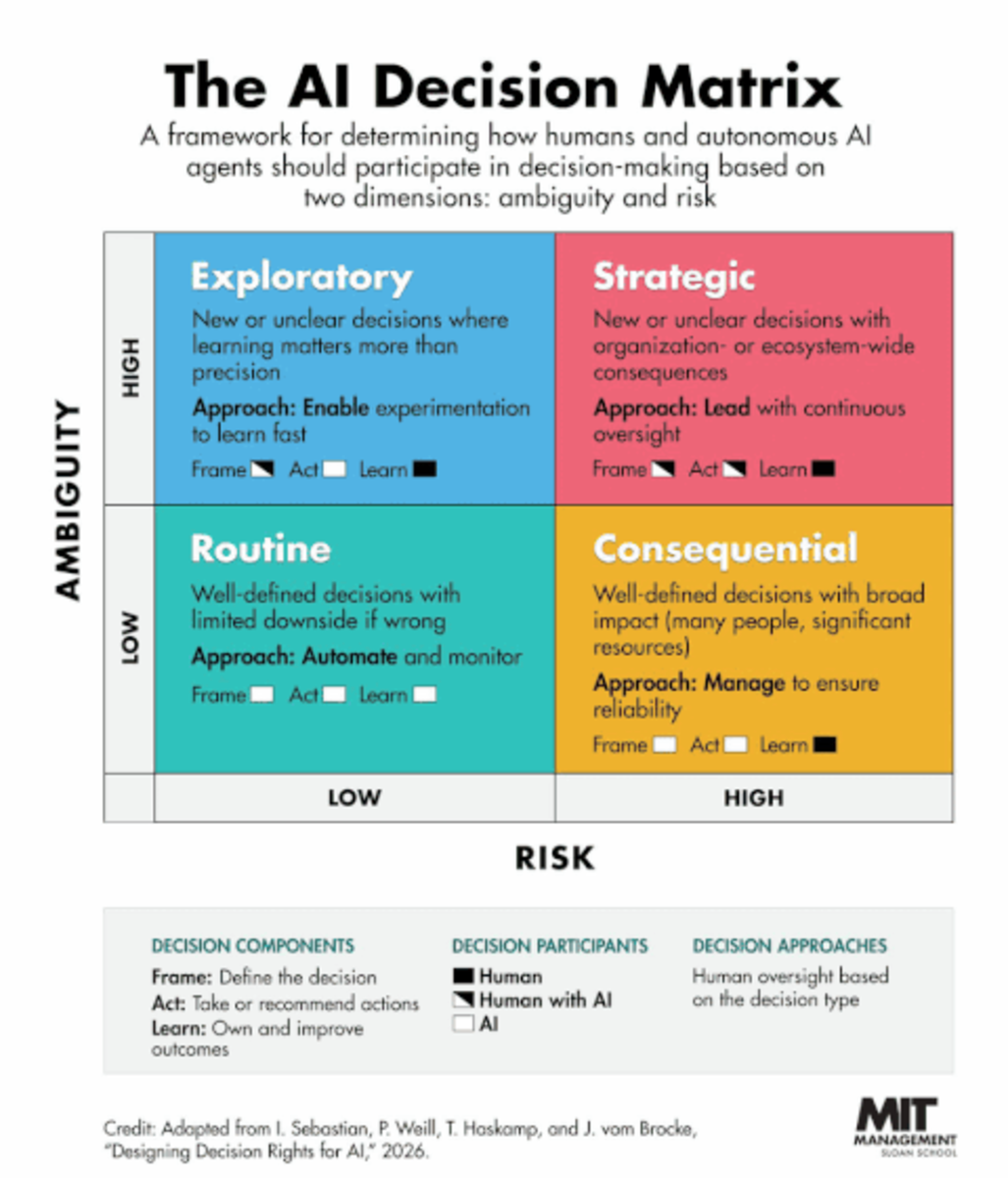
According to MIT's AI Decision Matrix, every workflow breaks down across two axes, ambiguity and risk, and three operational steps: Frame, Act, and Learn.
Instead of treating "human-in-the-loop" as a vague buzzword, you explicitly assign every single step to a human, the agent, or both.
Routine (Low Risk / Low Ambiguity): automate end-to-end. Keep a safety net until trust is earned.
Consequential (High Risk / Low Ambiguity): let the agent execute, humans supervise and handle edge cases.
Exploratory (Low Risk / High Ambiguity): co-create the approach. AI executes, humans absorb the insights.
Strategic (High Risk / High Ambiguity): humans steer completely. AI acts strictly as an advisor.
Stop grading use cases by their title. A "safe" assistant becomes high-risk the second it gains the permission to move funds. Real-world operators like Telco One New Zealand manage 50+ agents this way, pairing every single agent with a named human owner.
Which quadrant do most of your agents live in right now?