For the past few years, leaders have been told to learn how to prompt AI.
The harder question is now arriving: what work are you actually willing to hand over to it?
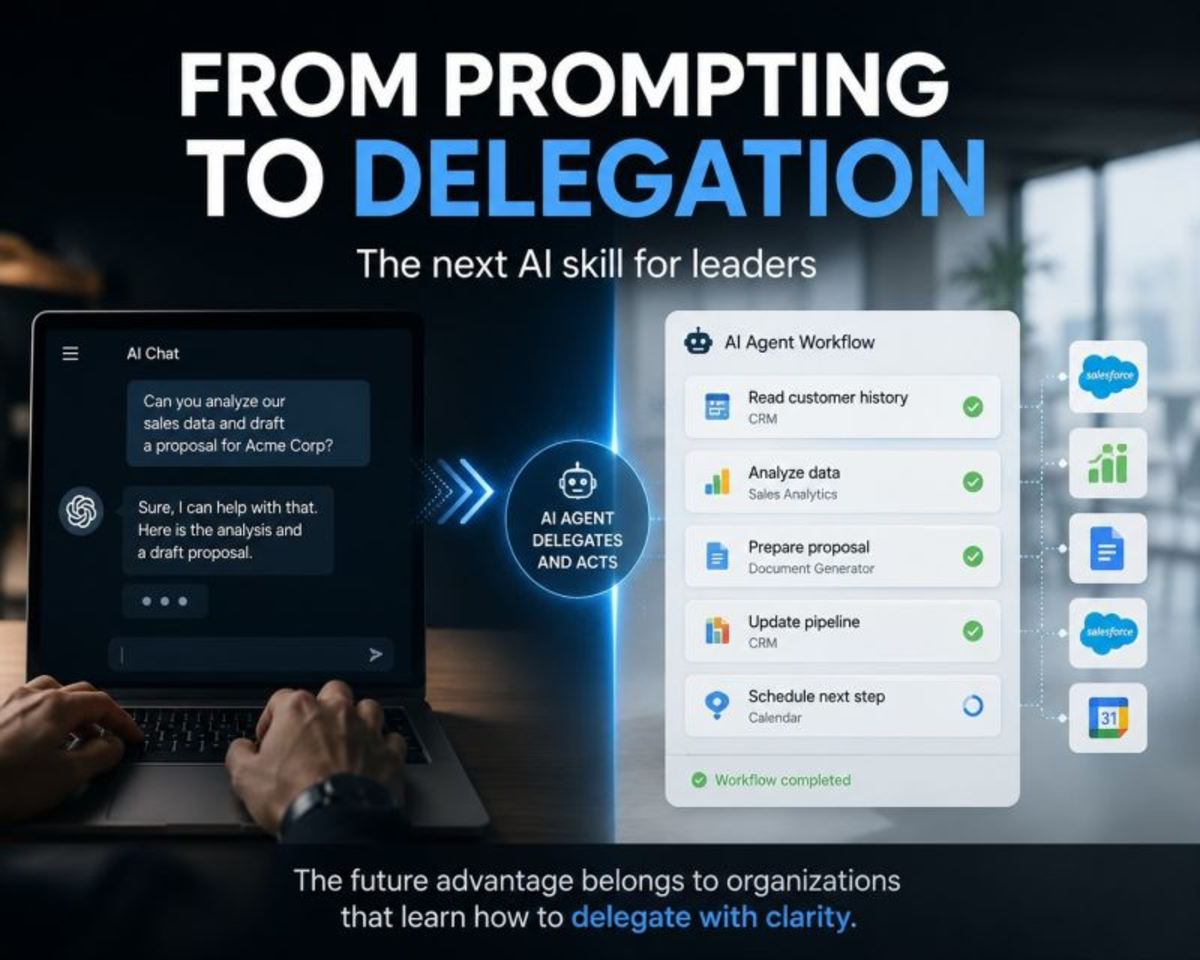
Imagine an AI agent opening your CRM, reading customer history, preparing a proposal, updating the pipeline and scheduling the next action.
Nobody is asking it a question anymore.
Work has been delegated.
OpenAI's Enterprise Signals from August gives a useful indication of how quickly this is moving. In June, Codex accounted for 64% of the combined Codex and ChatGPT output tokens among enterprise customers.
The interesting part is not the number itself.
It is what changes when AI moves from giving answers to taking action.
Delegation requires architecture.
What context can the agent access? Which systems can it change? How much authority does it have? When should a human step in? And who remains accountable when the outcome is wrong?
For decades, organisations have built structures for delegating work between people. Roles, permissions, escalation paths, supervision and accountability all exist for a reason.
AI agents are now entering that same organisational structure.
Giving them more autonomy without redesigning those boundaries is simply adding a new actor to an old system and assuming the rules will still work.
The companies that move furthest with agents may not be the ones with the best prompts.
They may be the ones that learn how to delegate with clarity.
What would you genuinely be comfortable letting an AI agent own inside your organisation?