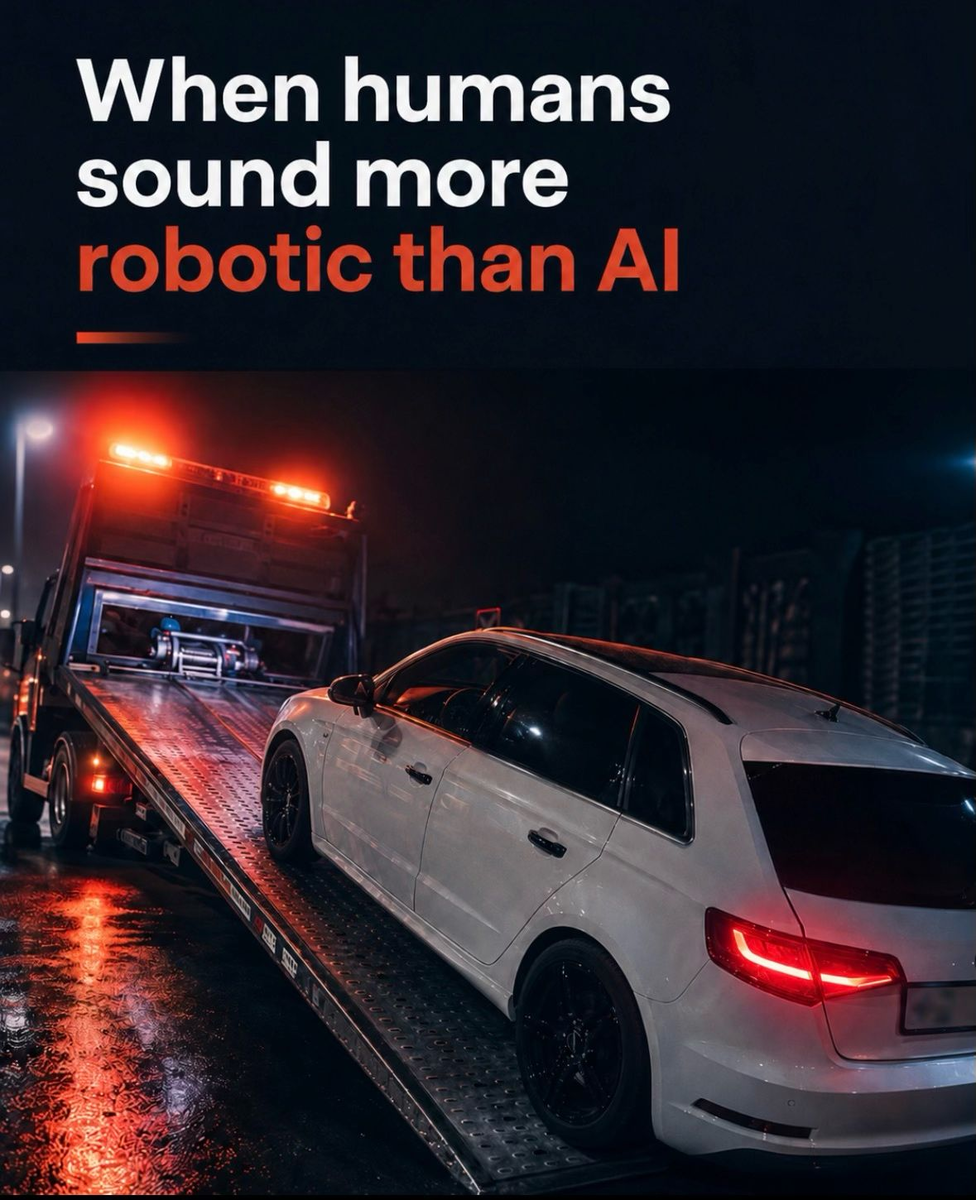
The most robotic conversations I had last week were with humans.
And it made me question something we rarely ask in AI:
Are we sure we should make AI as human as possible?
Last week, on my road trip home, my car broke down in France.
I was travelling with my three daughters. Late at night, after being towed away, we were dropped in Massiac, a tiny mountain village.
No car. Luggage in hand. No idea where we would sleep.
ANWB had the full case. They knew where we were and who I was travelling with.
Yet the message was basically: arrange a hotel yourself, figure out how to get there yourself.
So we walked.
We found a hotel. Closed. No reception. Just a phone number on the door.
I called.
A man answered. There was barely a room and little flexibility.
Then he heard my accent.
“Where are you from?”
“Morocco.”
Everything changed.
He switched to Arabic.
“I’m Ilyas HAJFANI from Fani Hotels. Brother, don’t worry.”
Within minutes, he arranged a better room, told us to stay as long as we needed, then gave us an extra day free of charge and refused payment.
The problem had not disappeared. But the helplessness had.
Thank you, Ilyas HAJFANI and Fani Hotels.
For a father trying to stay strong for his daughters, your kindness gave me peace of mind exactly when I needed it.
Over the following days, the contrast with ANWB became even sharper.
I had to chase updates myself. Promised callbacks did not happen. At one point I was told my car had already been moved while I could literally see it still standing there.
Then came the lowest point.
During a later call, while I was explaining why the situation had become unacceptable, the employee simply hung up on me.
Yes, that made me angry. And deeply disappointed.
An organisation built to help people in distress had all the context, yet still communicated like a rigid chatbot.
That is where the AI lesson became uncomfortable.
In the AI agents and systems I work with, signals of distress in voice and language can change behaviour: slow down, change tone, stop the normal objective, or escalate.
The AI does not feel empathy.
But it can be designed to respond empathically.
ANWB had the data.
Ilyas had my voice and sense of human context.
Having context is not the same as understanding context.
A human can possess genuine empathy and still behave like a machine when scripts, processes or culture take over.
So perhaps the goal should not be to make AI as human as possible.
Humans can be extraordinarily compassionate, but also rigid, impatient and trapped by procedures.
The real challenge is deciding which parts of humanity are worth teaching AI.
Maybe AI’s biggest contribution will not be becoming more human.
Maybe it will force organisations to ask why their humans sometimes stopped behaving like humans in the first place.