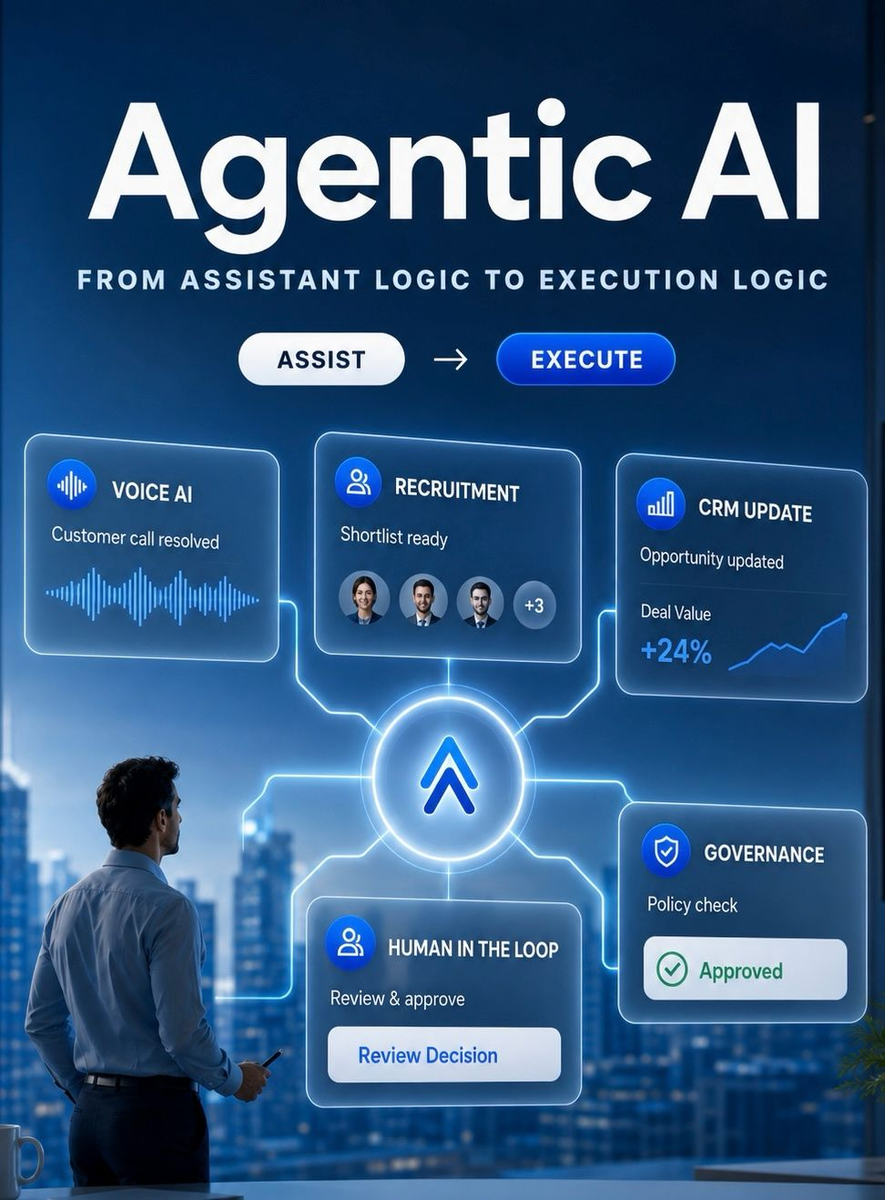
Agentic AI is moving from assistant logic to execution logic.
That may sound like a small shift. It is not.
It changes how companies design workflows, governance, procurement and responsibility.
For a long time, AI in companies was mostly about support.
Support for writing. Support for search. Support for analysis. Support for faster thinking.
That phase is not over, but something more serious is emerging now.
Agentic AI is moving from assistant logic to execution logic.
It becomes real when a system can carry a workflow from intent to outcome, with memory, permissions, escalation, governance and measurable business impact.
A voice agent that qualifies, books and updates the CRM. A recruitment system that follows up, filters and schedules. An HR workflow that resolves routine cases without breaking trust or compliance.
That is where AI moves from demo to infrastructure.
And this is also where many enterprise pilots still get stuck.
They treat agents as smarter chatbots, while the real value sits in workflow ownership. Not full autonomy everywhere, but carefully designed autonomy where repetition, context and decision rules are clear enough to be trusted.
This brings a second issue to the surface: sovereign AI.
Sovereignty is not only about where the model trains or which data center hosts it.
It is also about procurement, governance and operational control.
Where does the data live? Who governs the agent's decisions? Which workflows are we comfortable giving to non-human actors? Who carries responsibility when the system acts?
These questions will not be solved by compute alone.
This is why the Gulf has a serious opportunity. The region is not only talking about AI adoption. It is building infrastructure, attracting talent, investing in compute and moving closer to execution.
Europe still has deep knowledge, strong values and excellent engineers. But too often we move like observers of the next wave, while depending on others for the rails underneath our digital future.
The next 24 months will separate those who speak about AI from those who can absorb it, govern it and operate it at scale.
That is the conversation I want to bring forward.
More architecture. More responsibility. More proof.
The real question is: which parts of our organisations are mature enough to let AI execute, and which parts still need a human hand on the wheel?